
At FOSS Asia 2026 (Mar 8-10, Bangkok), note 7:
Cluster API has been around since 2018 and is increasingly the go-to approach for declarative Kubernetes cluster lifecycle management — though still in beta (v1beta1 → v1beta2). A Mirantis talk on CAPI’s pain points and what the open-source ecosystem is building on top of it got me curious.
The Reality Check#
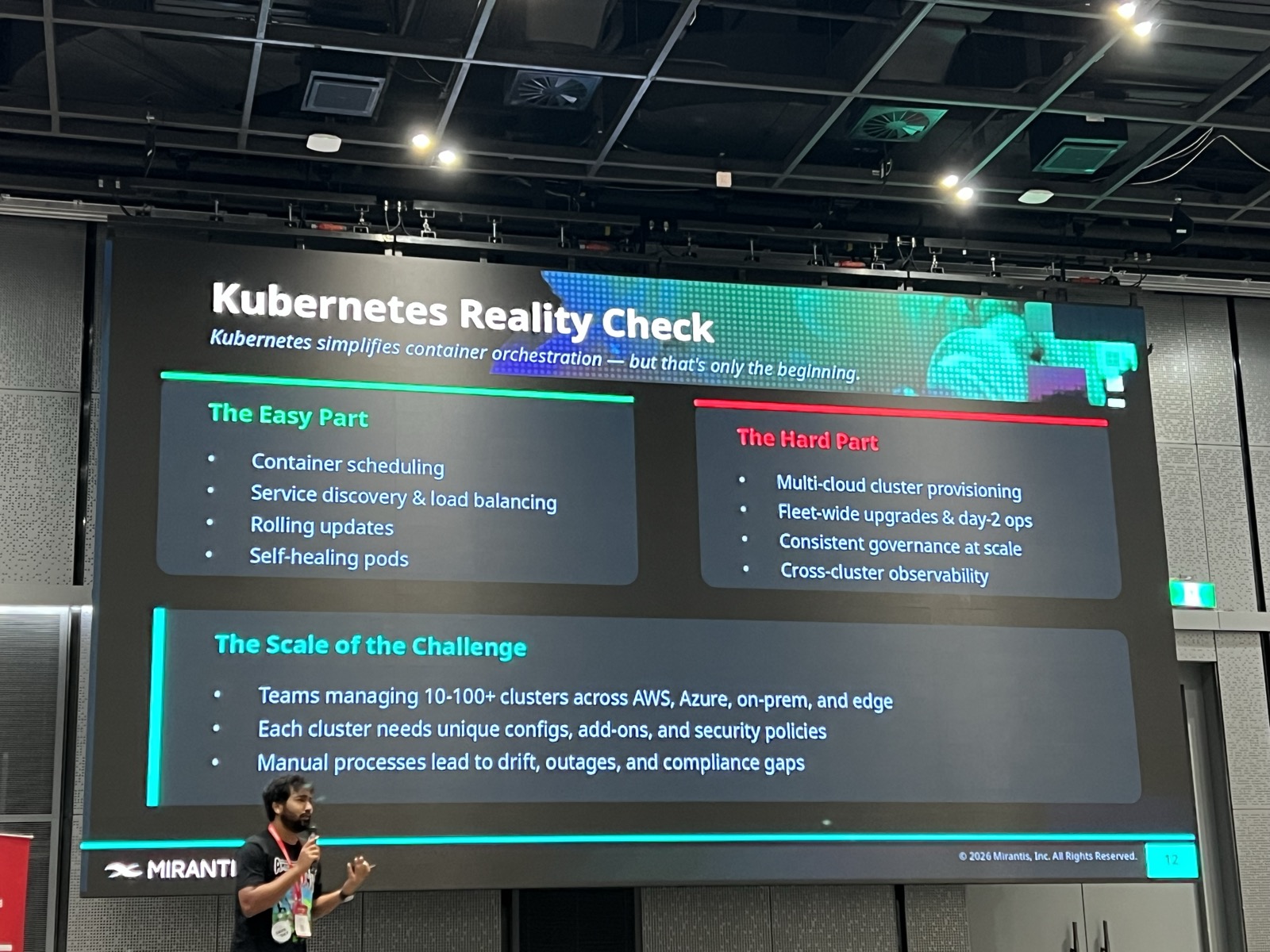
Kubernetes makes the basics easy — container scheduling, service discovery, rolling updates, self-healing pods. But once you’re managing 10-100+ clusters across AWS, Azure, on-prem, and edge, you hit a different class of problems: multi-cloud provisioning, fleet-wide upgrades, consistent governance, and cross-cluster observability.
What Is Cluster API?#
Cluster API (CAPI) is an official Kubernetes sub-project under SIG Cluster Lifecycle. The core idea: manage Kubernetes clusters the same way Kubernetes manages pods — declaratively, through manifests and controllers.
You run a management cluster with CAPI controllers, and those controllers provision and manage workload clusters on any infrastructure with a CAPI provider (AWS, Azure, vSphere, bare metal, etc.). There’s a clusterctl CLI to get started quickly — installing providers, generating manifests — but since CAPI is just Kubernetes CRDs, teams at scale typically manage it declaratively via GitOps (Flux, ArgoCD) or integrate it programmatically into their own tooling.
CAPI: Promise and Pain#
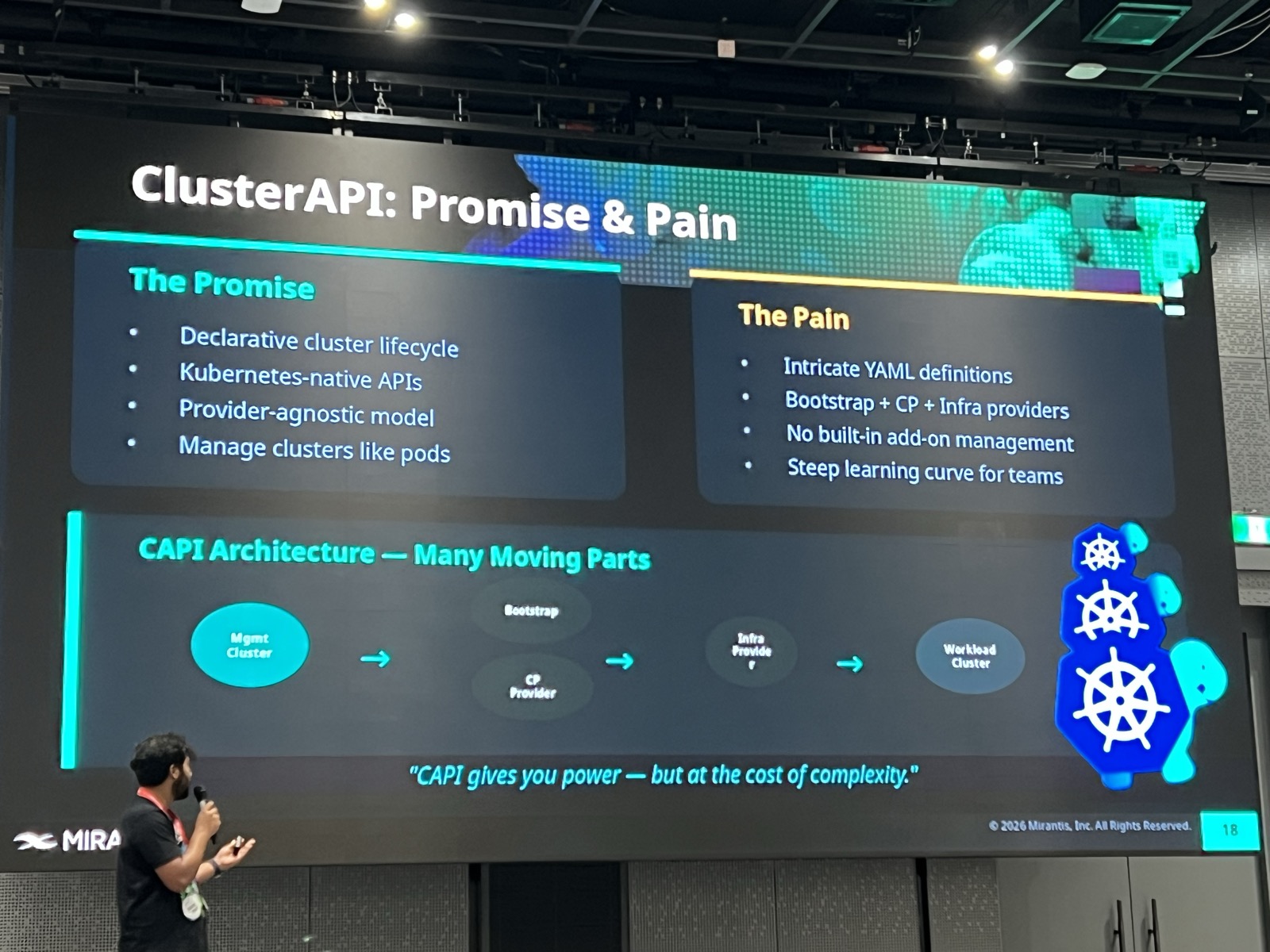
The speaker framed the tension well. CAPI promises declarative cluster lifecycle, Kubernetes-native APIs, a provider-agnostic model, and the ability to manage clusters like pods.
But the pain is real: intricate YAML definitions, juggling bootstrap + control plane + infrastructure providers, no built-in add-on management, and a steep learning curve.
The quote on the slide nailed it:
“CAPI gives you power — but at the cost of complexity.”
The Real-World Consequences#
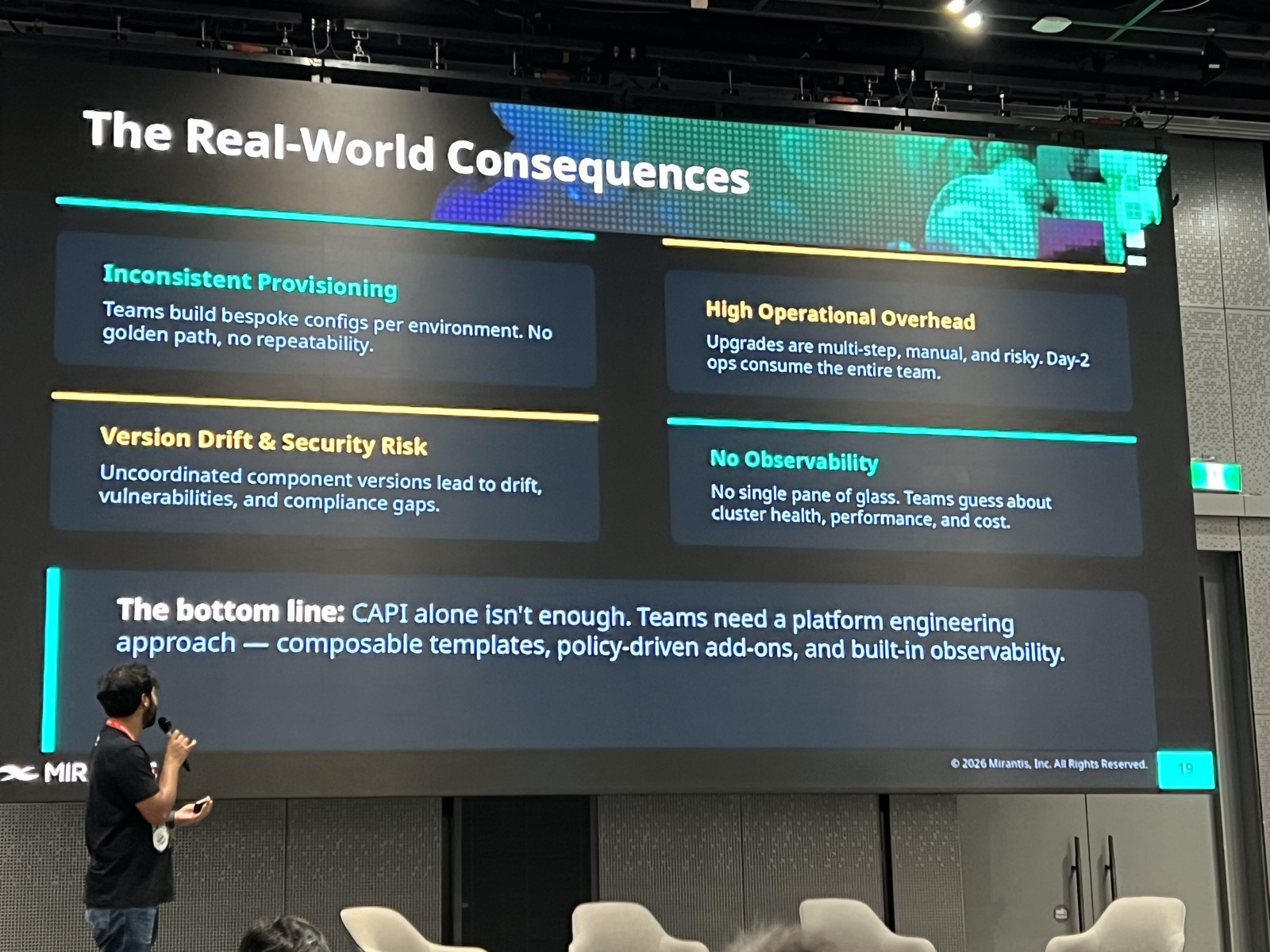
When teams use CAPI alone at scale, they run into inconsistent provisioning (bespoke configs per environment, no golden path), version drift and security risk, high operational overhead on day-2 ops, and no single pane of glass for observability.
The bottom line: CAPI alone isn’t enough. Teams need a platform engineering approach — composable templates, policy-driven add-ons, and built-in observability.
The Solution: k0rdent + Sveltos#
The talk argued that assembling raw open-source tools yourself is complex, and pre-integrated platforms aim to reduce that burden. This is where two open-source projects come in.
Sveltos#
Sveltos is an open-source Kubernetes add-on controller that addresses CAPI’s “no built-in add-on management” gap. It deploys Helm charts, raw YAML, Kustomize, and more across your entire fleet — with dependency ordering, drift detection, and multi-tenancy support.
k0rdent#
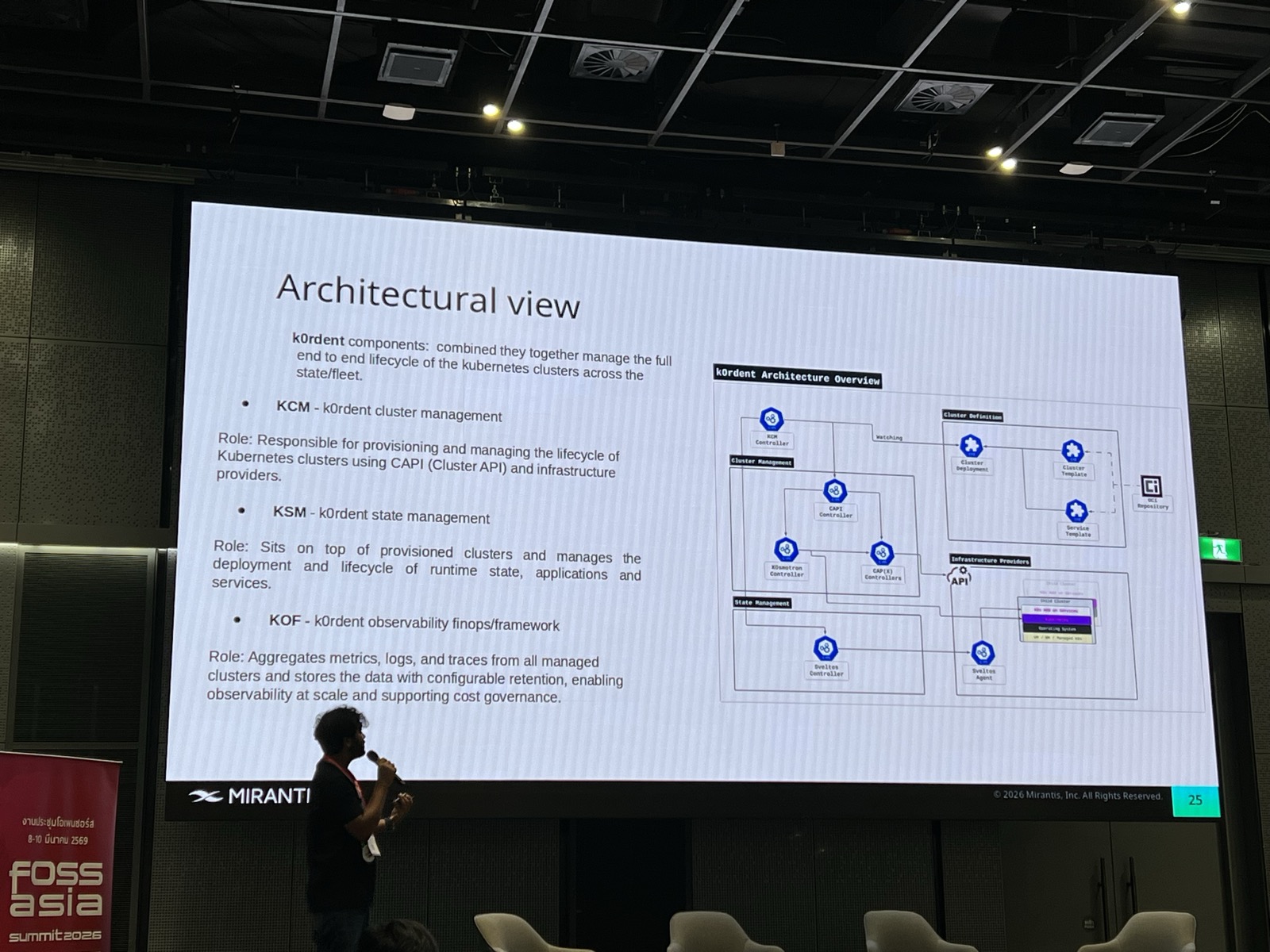
k0rdent is an open-source platform by Mirantis (open-sourced Feb 2025) that bundles everything together into three components:
- KCM (Cluster Manager) — provisions and manages cluster lifecycle using CAPI
- KSM (State Manager) — wraps Sveltos under the hood for add-on and application lifecycle
- KOF (Observability Framework) — aggregates metrics, logs, and traces from all managed clusters
Sveltos isn’t a separate tool you stitch together — it’s integrated as the state management engine inside k0rdent. The result addresses exactly what the speaker identified as CAPI’s shortcomings: add-on management, policy enforcement, and observability in one place.
The Takeaway#
If you’re running a handful of clusters, CAPI with some scripts on top might be fine. But at scale — tens or hundreds of clusters across multiple environments — you need templated provisioning, policy-driven add-ons, and centralized observability. The open-source ecosystem is maturing to fill this gap, and k0rdent’s approach of composing CAPI + Sveltos + observability into a coherent platform is a pragmatic path — all components are open source, no vendor lock-in.