
At FOSS Asia 2026 (Mar 8-10, Bangkok), note 6:
There was a talk on authentication and security enforcement in PostgreSQL. PostgreSQL relies on extensions for non-essential features, and credential policy enforcement is one of those gaps in the extension ecosystem that credcheck fills nicely.
It enforces password and username rules during user creation and password changes.
What it can enforce#
Password rules:
- Minimum length, required digits, uppercase, lowercase, special characters
- Maximum character repetition
- Password cannot contain username
- Password reuse prevention (history-based)
- Password expiration with configurable valid period
Username rules — this was surprising, the extension validates usernames too:
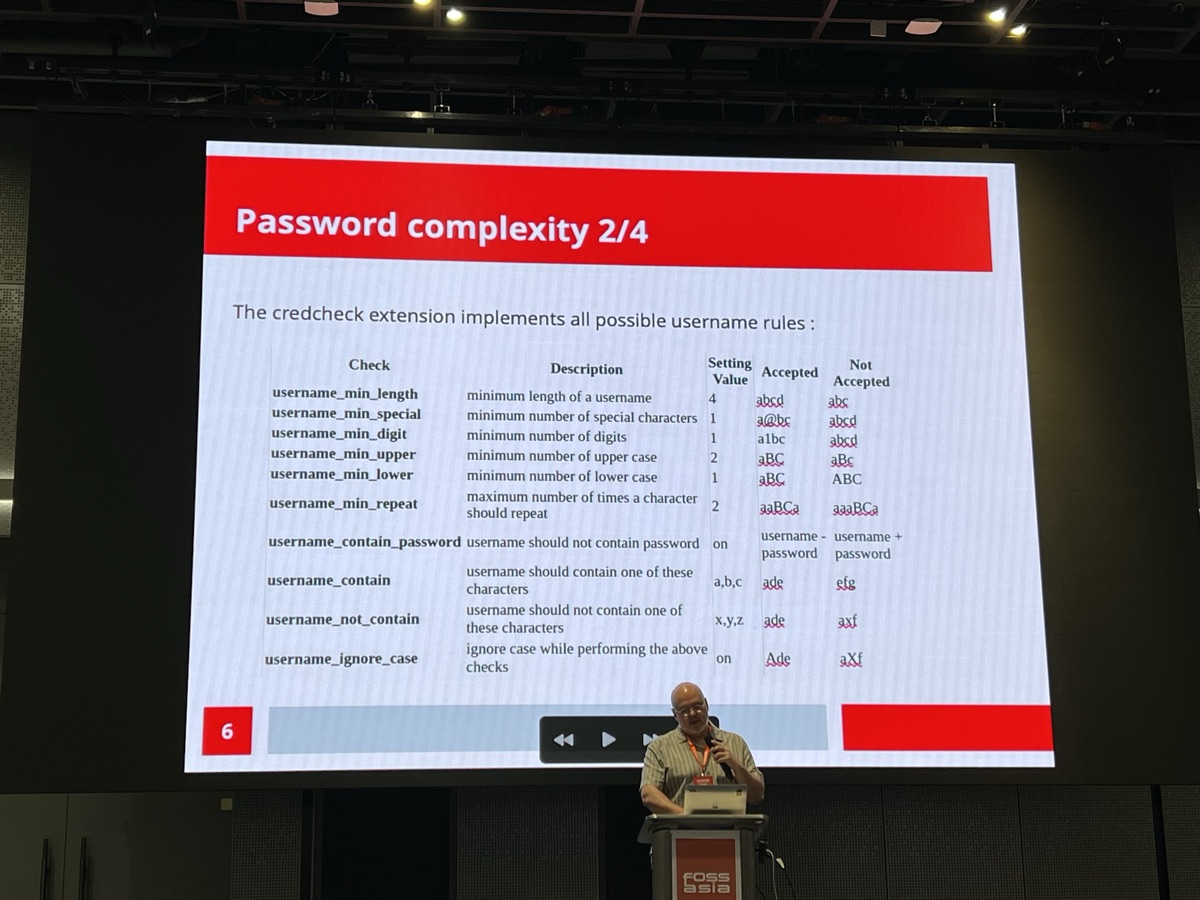
Minimum length, required character types, must/must-not contain specific characters — all configurable.
Authentication failure protection#
credcheck can also ban users after N failed login attempts:
SET credcheck.max_auth_failure = 3;After 3 failures, the user is locked out even with the correct password. Admins can unban with SELECT pg_banned_role_reset('username').
Setup#
Add to shared_preload_libraries in postgresql.conf and restart:
shared_preload_libraries = 'credcheck'Then configure via GUC parameters:
SET credcheck.password_min_length = 8;
SET credcheck.password_min_upper = 1;
SET credcheck.password_min_digit = 1;
SET credcheck.password_min_special = 1;
SET credcheck.password_reuse_history = 3;
SET credcheck.password_valid_until = 60;  -- days
Logging and auditing#
The talk also covered PostgreSQL security basics worth mentioning:
- Enable
log_connection/log_disconnectioninpostgresql.conf - Use
%u, %d, %h, %ainlog_line_prefix(user, database, host, application) - Use pg_audit extension for detailed audit logging
- Send logs to a remote host with rsyslog